 Tacuco
Educational Activities
Picture Dominoes: The Simple Game That Packs a Surprising Amount of Learning
Swap the dots for pictures and dominoes become a hands-on matching game for ages 3–8. Here's what the research says children practice while they play, plus six levels to grow the game with your kids at home.
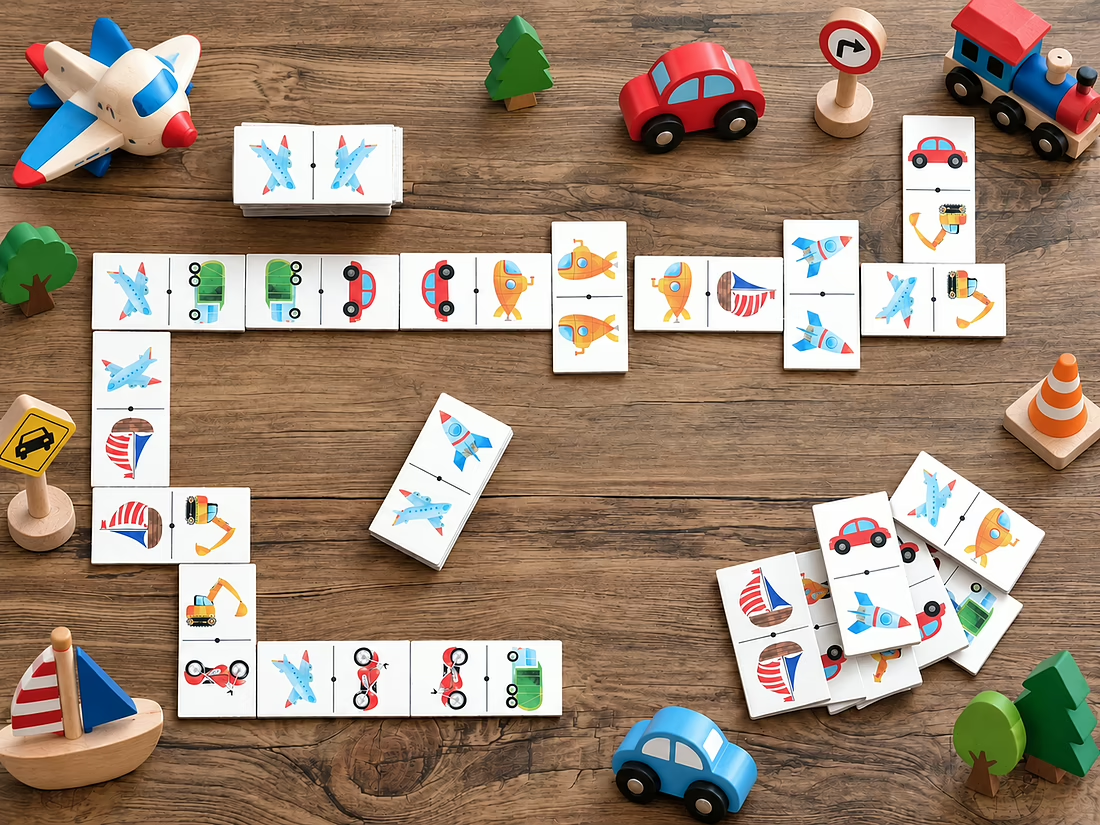
Dominoes look almost too simple to count as “school”. You put a tile down, find one that matches, and keep going.
Look a little closer, though. On every turn a child has to look, compare, choose, place the tile and sometimes wait. Swap the traditional dots for pictures such as a fox, a leaf or a butterfly, and even a three-year-old can play. That child doesn’t need to know any numbers yet.
This guide covers what children practise when they play picture dominoes, what the research actually says (and what it doesn’t), and how to use one set across many ages and subjects in your homeschool.
At a glance
- Ages: about 3–8, from first matching to strategy and early reading
- Skills practised: visual matching, attention, rule-following, vocabulary, turn-taking, careful hand movements
- Prep time: print, cut, and you’re ready
- Works for: independent work, parent and child, siblings, small groups
What happens in a single turn
Each turn asks a lot of a young child. They have to:
- Scan the tiles in their hand and the chain on the table.
- Compare the pictures and notice which ones are identical.
- Ignore the tiles that almost fit but don’t.
- Choose a tile, then turn it the right way and place it.
- Wait for their turn, and change plans when the spot they wanted is taken.
That one loop (look → compare → tell apart → match) brings together seeing, thinking, language, hand movement and social skills. And it repeats dozens of times in every game.
Why pictures instead of dots?
With traditional dominoes, a child has to know that five dots means five. Picture dominoes ask a more concrete question:
“Is this butterfly the same as that butterfly?”
The child can answer just by looking. That makes the game playable long before counting is solid.
Picture dominoes don’t replace number dominoes. The two practise different things:
| Number dominoes | Picture dominoes |
|---|---|
| Counting | Visual recognition |
| Quantity at a glance (subitizing) | Matching identical images |
| Number relationships | Vocabulary and conversation |
| Sorting and classifying |
Many families use picture dominoes first and add number dominoes once their child counts with confidence.
What the research says
There’s not much research on picture dominoes specifically. Several nearby areas of research all point the same way, though.
Preschoolers can learn real things from dominoes
In a year-long study published in Psicologia: Reflexão e Crítica, 20 preschool children played four domino games, each harder than the last. None of them had played dominoes before. Even so, errors stayed under 12% of moves, and both the children and the researcher caught and fixed mistakes. The authors describe domino play as a setting where children build knowledge together through interaction.
Matching is a foundational skill
Visual discrimination means noticing what is the same and what is different. Children use it later to tell apart letters such as b and d, numbers, shapes and symbols. Studies of matching tasks show that children learn identical-picture matching very early, some as young as 16–21 months. Studies also show that familiar pictures are easier for young children than unfamiliar symbols. That’s one reason a picture-first approach makes sense.
Board games and guided play help learning
- A systematic review of 27 board-game studies found that board games can support learning, social interaction and motivation. Results varied from game to game.
- A 2022 meta-analysis on guided play in Child Development covered 39 studies of children aged 1–8. Guided play gave better results than direct instruction for early math, shape knowledge and task switching.
- The American Academy of Pediatrics’ report The Power of Play names board games with clear goals as one form of guided play. It links play to self-regulation, language and problem solving.
What we won’t claim
No study has tested a specific picture domino set and shown that it “boosts IQ” or “develops executive function”. What the evidence does support is more modest and still useful: picture dominoes give children many chances to practise observation, attention, following rules, making decisions and taking turns. We’d rather tell you the truth than oversell it.
Six skills, one little game
👀 Visual discrimination. Every match trains careful looking.
🧠 Attention and self-control. Children keep the rule in mind and resist the tile that almost matches.
🗣️ Language. Pictures give you something to talk about, which dots don’t. Ask “Where does the fox live?” or “Which one can fly?” The game won’t teach words by itself. The conversation around it does.
🗂️ Classification. Once children know the game, sort the tiles: animals vs. plants, things that fly vs. things that don’t, forest vs. garden.
🤝 Social skills. Waiting, taking turns, accepting the end of a game and building one chain together all come up naturally.
✋ Fine motor. Picking up, turning and lining up tiles gives the hands useful practice. It’s a bonus, not a therapy.
The Montessori connection
Picture dominoes aren’t an official Montessori material. A well-designed set does fit several Montessori principles, though:
- Concrete before abstract. Children start with a real picture of a bird, then move to the word bird, and later to symbols and numbers.
- Control of error. If a fox touches a leaf, the child can see the mistake, so you don’t have to say “wrong”. Pointing quietly or asking “Do these match?” is enough.
- Independence and order. Keep the set in a box or tray on a low shelf. Your child takes it out, works with it and puts every piece back. That’s a full work cycle.
We call our games Montessori-inspired for this reason, and we encourage you to look for that same honesty wherever you shop.
How to present it (ages 3–6)
- Prepare. Put the full set in a small box or tray.
- Invite. “I have something to show you.”
- Demonstrate slowly. Place one tile, then find its match and set it so the pictures touch. Use few words.
- Repeat two or three matches.
- Hand it over. “Would you like to try?”
- Observe. Give your child time to search, and don’t correct every slip.
- Invite self-correction. If needed, point to the two touching pictures.
- Close the cycle. All the pieces go back in the box, and the box goes back on the shelf.
Questions that guide without giving away the answer:
- “What do you notice?”
- “Can you find the same picture?”
- “How do you know those two match?”
- “Is there another place it could go?”
Grow the game: six levels
| Level | What the child does | Main focus |
|---|---|---|
| 1. Identical matching | Pair exact pictures | Observation, concentration |
| 2. Domino chain | Play with the classic rules | Scanning, decisions, following rules |
| 3. Name it | Say the picture’s name before placing the tile | Vocabulary, speaking |
| 4. Sort it | Group the pictures into categories | Classification |
| 5. Picture to word | Match a picture to its printed word | Early reading |
| 6. Picture to silhouette | Match different versions of the same thing | Abstract thinking |
Each level moves a little further from same picture toward same idea.
Homeschool ideas for one set
- Independent work. A quiet chain while you help an older sibling.
- Sibling play. The preschooler matches while the older child names, sorts or plays to win.
- Nature study. Choose a theme that fits your season or unit, such as autumn, farm, dinosaurs or spring.
- Storytelling. At the end of the game, pick three pictures from the chain and tell a story about them.
- Memory challenge. Show four tiles, cover them, and ask which pictures were there.
- Family languages. Name the pictures in any language your family speaks. The picture stays the same and only the word changes.
Tips for choosing (or printing) a good set
- Clear, distinct pictures. Seven or eight images that look very different from each other. For beginners, avoid two birds that look alike.
- Consistency. The same object should look exactly the same on every tile.
- Plain backgrounds, so nothing competes with the picture.
- Pieces sized for small hands, large enough to handle easily and never a choking hazard.
- Realistic pictures if you want a stronger Montessori feel.
- A home for the set. A box or pouch keeps it complete and ready to use.
Printable sets make it easy to change themes with the seasons. You can laminate them or print on card stock so they last.
The bottom line
Picture dominoes are cheap, quick to set up and endlessly flexible. Research doesn’t promise miracles. It does show that well-designed, rule-based games give young children a real place to learn. That covers observing, deciding, talking and playing together. The game grows with your child for years.
Want to try it this week? Our Transportation Domino is ready to print. Looking for more hands-on materials? Browse the shop or pick up this month’s freebie.
References
- Santos, J. G. W., & Alves, J. M. (2000). O jogo de dominó como contexto interativo para a construção de conhecimentos por pré-escolares. Psicologia: Reflexão e Crítica, 13(3), 383–390.
- Yogman, M., Garner, A., Hutchinson, J., Hirsh-Pasek, K., & Golinkoff, R. M. (2018). The power of play: A pediatric role in enhancing development in young children. Pediatrics, 142(3).
- Skene, K., O’Farrelly, C. M., Byrne, E. M., Kirby, N., Stevens, E. C., & Ramchandani, P. G. (2022). Can guidance during play enhance children’s learning and development in educational contexts? A systematic review and meta-analysis. Child Development, 93(4), 1162–1180.
- Noda, S., Shirotsuki, K., & Nakao, M. (2019). The effectiveness of intervention with board games: A systematic review. BioPsychoSocial Medicine, 13, 22.
- Demangeon, A., Claudel-Valentin, S., Aubry, A., & Tazouti, Y. (2023). A meta-analysis of the effects of Montessori education on five fields of development and learning in preschool and school-age children. Contemporary Educational Psychology, 73, 102182.
- Randolph, J. J., et al. (2023). Montessori education’s impact on academic and nonacademic outcomes: A systematic review. Campbell Systematic Reviews, 19(3), e1330.
- Marshall, C. (2017). Montessori education: A review of the evidence base. npj Science of Learning, 2, 11.
- Association Montessori Internationale. Glossary of Montessori Terms (“Concrete to Abstract”, “Control of Error”).